
Picture this: You’re standing in a sales center with a potential buyer. You’ve got floor plans spread across the table, a few sample finishes, and maybe some architectural drawings. The buyer squints at the blueprints, trying to imagine their future home. They nod politely, say they’ll “think about it,” and walk out. Sound familiar?
Here’s what nobody tells you: That buyer isn’t thinking about it. They’re confused. And confused buyers don’t buy—they go to your competitor who showed them exactly what they’re getting with a crisp 3D rendering.
The Problem Nobody Talks About
Let’s be honest. Selling property that doesn’t exist yet is hard. You’re asking people to hand over hundreds of thousands of dollars for something they can’t see, touch, or walk through. It’s like asking someone to buy a car based on a sketch and a promise.
I talked to a developer in Miami last year who learned this the hard way. He launched a 150-unit condo project with traditional marketing—floor plans, a sample unit, and some artistic renderings his architect threw together. Six months in, he’d sold 22 units. His competitor down the street? They launched two months later with professional 3D renderings and virtual tours. They sold 89 units in the same timeframe.
The difference wasn’t the building. It was the visualization.
Here’s why traditional marketing falls short:
- People can’t read floor plans. Seriously. Unless you’re an architect or spent years in construction, those lines and numbers don’t translate to “this is where I’ll have morning coffee.”
- Sample units lie. That gorgeous show unit in Building A? Great. But your buyer’s looking at Building C, different floor, different view, different finishes. The connection doesn’t happen.
- Imagination has limits. Asking buyers to mentally overlay finishes, visualize views, and picture furniture layouts is asking too much. When they can’t see it, they don’t commit.
And here’s the kicker: Every week a buyer spends “thinking about it” costs you money. Carrying costs, interest, opportunity cost—it adds up fast.
What Is 3D Rendering, Really?
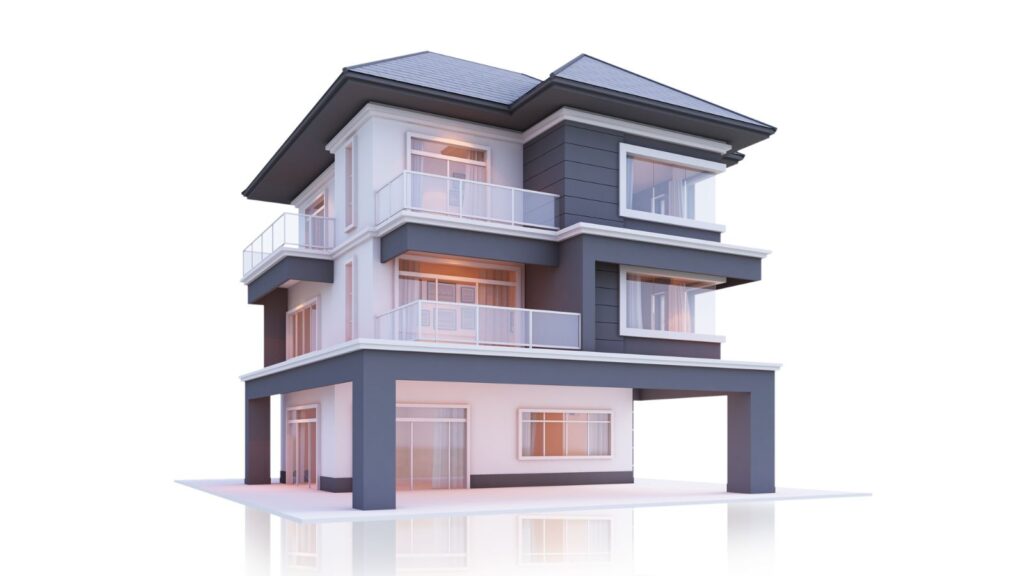
Okay, so what are we talking about here? 3D rendering isn’t just pretty pictures. It’s creating photorealistic images of your property before it exists. Think of it as photography from the future.
Professional 3D rendering for real estate takes your architectural plans and builds a complete digital version of the property. Every detail—from the grain in the hardwood floors to the way sunlight hits the kitchen counter at 3 PM—gets captured.
What you can show with 3D rendering:
Exteriors that sell the lifestyle:
- How the building looks from the street
- Landscaping and outdoor spaces
- The pool area at sunset
- How it fits into the neighborhood
Interiors that close deals:
- Exact finishes and color schemes
- Furniture layouts showing how spaces work
- Natural light at different times of day
- The actual view from each unit’s windows
- Kitchen and bathroom details that matter
Here’s what makes it different from those cheesy computer graphics you might be thinking of: Good 3D rendering looks real. Not “sort of real” or “good enough”—actually real. Buyers looking at a professional rendering shouldn’t be able to tell it from a photograph.
The technology behind this involves sophisticated software that simulates how light bounces off surfaces, how materials reflect and absorb, and how shadows fall naturally. It’s technical, but you don’t need to understand it. You just need to see the results.
The Pre-Sale Advantage You’re Missing
Let’s talk about what happens when you use 3D rendering for pre-construction sales. This is where the real money gets made (or lost).
A developer I know in Austin tracked his numbers across two similar projects. First project: traditional marketing. Second project: comprehensive 3D visualization. Here’s what changed:
Project 1 (Traditional):
- Average time from inquiry to contract: 52 days
- Site visits per buyer: 3-4 times
- Conversion rate: 11%
- Pre-construction sales before breaking ground: 38%
Project 2 (3D Rendering):
- Average time from inquiry to contract: 29 days
- Site visits per buyer: 1-2 times
- Conversion rate: 18%
- Pre-construction sales before breaking ground: 67%
That’s not a small difference. That’s the difference between starting construction with confidence and crossing your fingers hoping the market holds.
Why does this work so well?
Buyers make decisions faster when they’re confident. Simple as that. When someone can see their actual unit—not a sample, not a maybe-kinda-similar unit, but THEIR unit with THEIR view—they commit.
Plus, you unlock buyers you’d never reach otherwise:
- International buyers who aren’t flying in three times to look at floor plans
- Out-of-state investors making decisions remotely
- Busy professionals who don’t have time for multiple site visits
- First-time buyers who need extra help visualizing their purchase
I know a developer in Vancouver who sold 40% of his units to buyers in China and Hong Kong. They never set foot in Canada before buying. How? Virtual tours built from 3D renderings. They could walk through units, compare views from different floors, and see finish options—all from Shanghai.
That’s not just convenient. That’s a whole new market you couldn’t tap before.
When to Use Rendering vs. Real Photography
Here’s a question I get all the time: “Why not just wait and photograph the actual building?”
Good question. Here’s the answer: Timing.
Real estate development is all about momentum. You need deposits to secure financing. You need pre-sales to de-risk construction. You need buyer commitments to time your construction schedule. Waiting until you can photograph actual units means waiting 12-18 months. That’s 12-18 months of carrying costs and zero revenue.
Use 3D rendering when:
- You’re in pre-construction (obvious, but worth saying)
- You need to show different finish packages
- You want to visualize units that haven’t sold yet
- You’re marketing before sample units are ready
- You need consistency across all your marketing materials
Switch to photography when:
- Construction is complete
- You have model units that represent what buyers get
- You’re selling the last few units in a completed building
- You want to show actual build quality
But here’s the smart play: Use both. Start with 3D rendering for pre-construction sales. As you approach completion, blend in real photography. Then, when you’re done, switch entirely to photos. This gives you the best of both worlds—early sales momentum plus authentic proof of quality.
One developer told me he spent $35,000 on 3D renderings for a 180-unit project. Those renderings generated $8 million in deposits before he poured the first foundation. Try getting that ROI from anything else in your budget.

How Much Does This Actually Cost?
Let’s talk numbers because this is probably what you’re really wondering.
3D rendering isn’t cheap, but it’s not as expensive as you might think. More importantly, it’s not an expense—it’s an investment with measurable returns.
Typical pricing breakdown:
Basic package (8-10 images):
- Cost: $12,000-$20,000
- What you get: Key exterior shots, a few interior renderings
- Best for: Smaller projects or tight budgets
Standard package (15-20 images + virtual tour):
- Cost: $30,000-$45,000
- What you get: Comprehensive interiors, exteriors, amenity spaces
- Best for: Most mid-size developments (100-300 units)
Premium package (25+ images, animations, VR):
- Cost: $55,000-$80,000
- What you get: Everything plus walkthrough videos, VR experiences
- Best for: Luxury developments or projects targeting international buyers
Now, before you freak out about those numbers, let me put it in perspective. That $30,000-$45,000 standard package for a 200-unit building? That’s about 0.2% of your development costs. But it influences maybe 30-40% of your sales effectiveness.
Think about it: You’re spending millions on construction. Hundreds of thousands on marketing. But the thing that actually helps buyers decide? You’re considering skipping it to save $35,000?
A developer in Phoenix told me his rendering investment paid for itself in the first week of sales. He calculated that faster sales saved him about $180,000 in carrying costs over six months. Plus, he sold at higher prices because buyers were more confident.
That’s not even counting the intangible benefits: fewer site visits (saving sales team time), better qualified leads (people who’ve already seen units online), and international reach.
Finding the Right Rendering Partner
Okay, so you’re sold on the idea. Now comes the hard part: finding someone who can actually deliver quality work.
Not all rendering companies are created equal. I’ve seen absolutely stunning work that looks better than real photography. And I’ve seen stuff that looks like it came from a video game circa 2005. The difference? It’s not just talent—it’s experience with real estate specifically.
What to look for:
Portfolio that matches your project:
- Ask to see completed developments similar to yours
- Look at how they handle materials—does marble look like marble?
- Check lighting quality—does it look natural or artificial?
- Examine details—can you see texture in fabrics and finishes?
Developer references:
- Don’t just ask if they’re happy—ask specific questions
- Did renderings match the final product?
- How was the revision process?
- Did they hit deadlines?
- Would you use them again?
Technical capability:
- What software do they use? (Industry standard: 3ds Max, V-Ray, Corona)
- How long have they been doing real estate rendering specifically?
- Can they work from your architect’s files directly?
- What’s their revision process?
Red flags to watch for:
- Prices way below market (you get what you pay for)
- No real estate portfolio (wedding photographers are great at weddings, not buildings)
- Unwilling to provide references
- Pushy about adding features you don’t need
- Can’t explain their process clearly
I knew a developer who went with the cheapest bid. The renderings came back looking like plastic toys. He ended up paying another company to redo everything, spending twice what he would have if he’d chosen quality first.
Don’t be that guy.
The Bottom Line: Is It Worth It?
Let me answer this with a question: Can you afford not to?
Your competitors are using 3D rendering. International buyers expect it. First-time buyers need it. And every week you delay sales costs you real money in carrying costs and opportunity loss.
Here’s the math that matters:
- Rendering investment: $30,000-$45,000 (typical mid-size project)
- Faster sales: 3-4 months earlier sellout
- Carrying cost savings: $150,000-$250,000
- Higher prices: 2-4% premium on average
- International buyer access: 20-30% market expansion
Even if rendering only delivered half those benefits, it’s still a no-brainer.
But here’s what really convinced me: I’ve never met a developer who regretted using professional 3D rendering. Not one. But I’ve met plenty who regretted skipping it.
They’re the ones watching competitors sell out while they’re still trying to explain floor plans. They’re the ones losing international buyers to buildings with better visualization. They’re the ones stuck with unsold inventory when construction completes.
Don’t be that developer.
3D rendering isn’t about making pretty pictures. It’s about de-risking your development, accelerating your sales, and capturing premium pricing. It’s about giving buyers the confidence to commit before you’ve laid a single brick.
That confidence turns into deposits. Deposits turn into construction financing. And faster sales turn into better returns.
The question isn’t whether 3D rendering is worth the investment. The question is whether you can afford to skip it while your competitors don’t.